God Running

Matthew 22:37-40 — All the Law and the Prophets hang on these two commandments

Love and InterruptionsI hate to be interrupted. I’m convinced that’s the reason God put me in a career with the fire service. Working for a fire department, you’re constantly interrupted by calls to help other people with their problems. After years of “training” for interruptions in that environment, I still sometimes find myself frustrated when my project work is unexpectedly delayed by people.

Today was one of those days. I was determined that today would be the day I finished the creation of a Kindle version of Traveler and the Chaplain, but, God had other things in mind. The morning started out with an emergency repair of a door lock accompanied by a great fifteen minute visit with my neighbor Tom. That was followed by the discovery of a dead battery in my 1994 Camry. So I called Kathy who returned home to give me a jump. Then we ran the Camry over to the shop. Then we grabbed some lunch and ate it on the way to an appointment where I dropped her off. We had a nice 30 minute conversation on the way. That was followed by a visit with an old friend who gave me a fantastic history lesson about some of the U.S. Army’s battles with Indians in Eastern Oregon. That was followed by dinner with my son, daughter (in-law), and grandson.

Not one word was written today toward completing the Traveler and the Chaplain Kindle version.

But what a great day it was. What tremendous opportunities I was given to pour into relationships today.


How Jesus loved people:

God’s way isn’t our way. Jesus’ life was full of interruptions. Please heal my son, the Royal Official begged Jesus. (John 4:46-54) While He was traveling, a leper came to him and begged him on his knees, “If you are willing, you can make me clean.” (Mark 1:40-45) While He was teaching the paralytic’s friends lowered the man down through the roof so Jesus could heal him. (Luke 5:17-26) On and on it goes — one interruption after another.


How you can too:

Obviously you and I don’t have the same gift of healing that Jesus has. But you and I can choose to respond to people who interrupt us, the same way that Jesus did. He responded in a welcoming way. He responded in a warm way. He responded with love. You and I can too.

Life’s about relationships, with God, and with people.

Even when they come in the form of an interruption.


“‘Love the Lord your God with all your heart and with all your soul and with all your mind.’ This is the first and greatest commandment. And the second is like it: ‘Love your neighbor as yourself.’

All the Law and the Prophets hang on these two commandments.”

–Jesus Christ, Matthew 22:37-40


[Image via: auq84, Creative Commons]

Matthew 18:23-35 — Shouldn’t you have mercy on your fellow servant, just as I had mercy on you?

Like you, I’ve been forgiven much. Like you I’ve been shown amazing grace. Yet I still find myself criticizing others and struggling to forgive at times.

With that in mind, I find these words from Jesus to be sobering.

“Therefore, the Kingdom of Heaven can be compared to a king who decided to bring his accounts up to date with servants who had borrowed money from him. In the process, one of his debtors was brought in who owed him millions of dollars. He couldn’t pay, so his master ordered that he be sold—along with his wife, his children, and everything he owned—to pay the debt.

But the man fell down before his master and begged him, ‘Please, be patient with me, and I will pay it all.’ Then his master was filled with pity for him, and he released him and forgave his debt.

“But when the man left the king, he went to a fellow servant who owed him a few thousand dollars. He grabbed him by the throat and demanded instant payment.

“His fellow servant fell down before him and begged for a little more time. ‘Be patient with me, and I will pay it,’ he pleaded. But his creditor wouldn’t wait. He had the man arrested and put in prison until the debt could be paid in full.

“When some of the other servants saw this, they were very upset. They went to the king and told him everything that had happened. Then the king called in the man he had forgiven and said, ‘You evil servant! I forgave you that tremendous debt because you pleaded with me. Shouldn’t you have mercy on your fellow servant, just as I had mercy on you?’ Then the angry king sent the man to prison to be tortured until he had paid his entire debt.

“That’s what my heavenly Father will do to you if you refuse to forgive your brothers and sisters from your heart.”

Lord have mercy on us. Bless us with great ability to show grace. Bless us with an ability to forgive.

In Jesus’ name.

Genesis 31:22-55 — Jacob was angry and took Laban to task

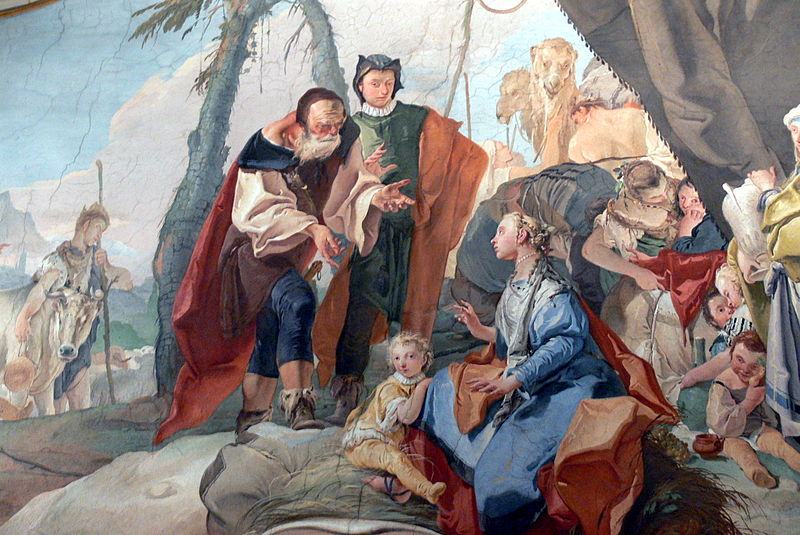
“Laban is looking for idols” by Giovanni Battista Tiepolo

Last post we left Jacob in the act of fleeing from Laban. He had fulfilled all of his obligations to Laban and had received four keys that helped him to know that moving his family to Canaan was the right thing to do. Four keys that you and I can use to help us know what God’s direction is for us in our lives. (see previous post on knowing God’s direction)


Genesis 31:22-55

We pick up our story with Jacob three days travel away from Laban. But on that third day, Laban is told that Jacob has fled. So he gathers up his relatives and he chases after Jacob. After seven days he catches up to him in the hill country of Gilead. That night though, God comes to Laban in a dream and says, Be careful not to say anything to Jacob, either good or bad. (Some translate this as the LORD instructing Laban not to begin by speaking kindly to Jacob but then turning on him later, as has been the pattern with Laban. Matthew Henry translates it the same as Genesis 24:50 where, regarding Abraham’s servant’s return home with Rebekah, Laban and Bethuel say, “This is from the LORD; we can say nothing to you one way or the other.” Either way, Laban is warned by the LORD.)

Jacob had already made camp in the hills of Gilead when Laban showed up. Laban and his relatives set up camp there too. Then Laban says to Jacob, What are you doing? You pulled a fast one on me, and made off with my daughters like they were prisoners of war. Why did you sneak off like that? Why didn’t you let me know so I could throw you a going away party? You never even gave me a chance to kiss my grand-kids and my daughters goodbye. You acted foolishly. I and my family gathered here could do you harm, but, last night the God of your father said to me, Be careful not to say anything to Jacob, either good or bad. (Whatever the meaning of God’s message to Laban, the result was that Laban refrained from harming Jacob, out of fear of the LORD) Laban continued, So you took off because you want to return to your own family, alright, I get that. But why did you steal my gods?

Jacob answers, I was afraid. You outnumber me so I figured you’d take your daughters from me by force. But as for your gods, if you find anyone who has them, that person shall not live. Jacob said this, not realizing that Rachel had indeed stolen her father’s gods. Right here, right now, in the presence of our relatives, Jacob continues, go ahead and see for yourself whether there’s anything here that belongs to you. And if you find anything, then take it.

So Laban takes Jacob up on his offer and goes from Jacob’s tent, to Leah’s, to the tents of the two female servants, but of course he finds nothing. Then he comes to Rachel’s tent. Well Rachel had already hidden her father’s household gods in her camel’s saddle. And when her father came in to perform his search, there sat Rachel on top of that saddle. Laban rummages through everything in Rachel’s tent except for what was under the saddle. Rachel says to her father, “Don’t be angry, my lord, that I cannot stand up in your presence; I’m having my (menstrual) period.” (v.35) So he searched her tent except for the camel saddle, and he came up dry.

It’s worth noting that Jacob’s God, the one and only true and living God, spoke to Laban and protected Jacob. Whereas Laban’s gods weren’t even able to make their presence known to Laban from a few feet away. Laban’s gods were nothing more than a couple of small statues carved by men and stolen by a woman. As for you and I, we can celebrate the kingdom, the power, and the glory of our God. Unlike Laban, while our goods could be stolen from us, our God can never be taken from us. And unlike Laban, who couldn’t find his gods, anyone who seeks the true and living God will find Him. In fact He wants to be found. (see So Your Life Is Falling Apart)

Now Jacob is angry and he rips on Laban, What have I done to you? he asks. What justification do you have to hunt me down like this? You’ve turned my whole camp upside down looking for your gods, and what have you found that belongs to you? Go ahead, put it all here in front of everybody, let them judge between us!

For twenty years I’ve been loyal to you. Under my care your sheep and goats haven’t miscarried, I haven’t eaten rams from your flock. I never brought you animals torn up by wild beasts, instead I always bore the loss myself. And you demanded payment from me whenever an animal was stolen from the flock by someone else. I worked in the heat of the day and stayed out with those flocks in the cold sleepless night. It was like this for twenty years with you. Fourteen years for your two daughters and then six years for your flocks, during which you changed my wages ten times. If it weren’t for the God of my father, the God of Abraham and the Fear of Isaac, you would have sent me away empty handed. But the LORD has seen all of the hardship and hard work, and last night He rebuked you.

Jacob lost his cool. He let his anger fly. Maybe like me you’ve had a Jacob moment like this one. It has certainly broken my heart when I’ve lost it, and it breaks my heart to see Jacob lose it here, for a couple of reasons. First of all Jacob’s wrong! He doesn’t realize that Rachel has in fact stolen from her father. One reason to keep your head when you think you’ve been wronged is that you can never know all there is to know about any situation. What we know about the past is a tiny fraction of all that’s occurred and it’s skewed by what others have told us, from their perspective, which may or may not be accurate. It’s also skewed by what people haven’t told us. In Jacob’s case Rachel hasn’t told him that she stole from her father. When you think you’ve been wrongfully accused, keep your cool, you never know what might be missing from your assessment of the situation.

The second reason Jacob’s rant breaks my heart is the way it blows his witness. That whole righteous indignation thing can feel so good, as we let our feelings go, as we vent, as we pop the cork and let the pressure out. But what about our witness? And what does God think of us when we behave like that? Romans 14 tells us that the kingdom of God is righteousness, peace and joy in the Holy Spirit, and God’s word goes on to tell us that’s because anyone who serves Christ in this way is pleasing to God and receives human approval. (Romans 14:17-18) In spite of Laban’s deceiving, defrauding, and double-crossing for the last twenty years, Jacob served him with righteousness, peace, and joy. Jacob served him in a way that pleased God and demonstrated a tremendous witness to Laban and all those around him. Then, right at the very end, he blows his stack. In so doing he discounted a great witness that was twenty years in the making. If you’re doing well, don’t grow weary in well doing. Your serving with righteousness, peace, and joy is precious in God’s sight and it attracts people to Christ. Don’t unravel that service that’s a masterpiece from God’s perspective, by letting loose of your feelings. It’s destructive on multiple levels.

Back to our story: So after a rant like that one, what can Laban say? He answers, These women are my daughters, these kids are my grand-kids, these flocks are my flocks. Everything you see here is mine. (These are some interesting comments by Laban. Though he may have felt that way; though he may have felt that the women, kids, and flocks were his, Jacob had more than fulfilled his part of the bargain to receive them as his own. Regardless of Laban’s feelings, all that Laban saw belonged to Jacob.) Laban continued, Yet what can I do but let them go with you. Let’s make a covenant, and let it serve as a witness between us in the future.

So Jacob takes a stone and sets it up as a pillar. Then he has his relatives gather more stones and they pile them in a heap. Both Jacob and Laban’s camps then eat there together, by the heap of stones. Laban calls it Jegar Sahadutha and Jacob names it Galeed — both mean “heap of witness.”

The heap of stones was also called Mizpah, which means “watchtower” because Laban said, May the LORD keep watch between you and me when we’re apart from each other. If you don’t treat my daughters right, or if you take on wives besides them, even though no one’s around to see it, you remember that God is a witness between you and me.

Laban says, This heap is a witness between you and me today.

Laban also says, I won’t go past this heap to your side to harm you and you don’t go past this heap to my side to harm me. May the God of Abraham and the God of Nahor, the God of their father, judge between us.

Knowing how God’s hand was on Jacob, this was a shrewd move on Laban’s part. He could only expect Jacob to grow stronger and stronger as time went on. It was prudent on his part to make a treaty with Jacob to protect himself against that day that would surely come, when Jacob was greater than Laban.

So Jacob takes an oath in the name of the Fear of his father Isaac. He offers a sacrifice there in the hill country of Gilead and invites his family to the meal. After they finish, they spend the night there.

Early the next morning, Laban kisses his grand-kids and his daughters and blesses them. (Notice that there’s no mention of a kiss for Jacob) Then he leaves and returns home.


In-laws and Christ’s law:

In-laws. Movies are made about them. Books are written describing them. There are even websites for people who want to share about how much they hate their in-laws. In my experience I’ve found it to be fairly rare for young families to get along well with their in-laws. (Fortunately for me, I’m blessed to be one of these rare cases. Though I don’t deserve it, my in-laws are great people.) I’ve found it to be much more common for people to struggle in their relationships with their in-laws. From the son-in-law or daughter-in-law’s perspective, mother-in-law (not always, but usually the mother-in-law seems to be the villain) is meddling and manipulative. From the mother-in-law’s (or father-in-law’s) perspective, son-in-law is nowhere near good enough for their little princess, or daughter-in-law is nowhere near good enough for their little prince.

Well then, as an in-law, how should we behave toward our spouse’s family? One way would be to respond as that great, wise, and oft-quoted philosopher Eminem prescribes. “I don’t care if you’re black, white, straight, bisexual, gay, lesbian, short, tall, fat, skinny, rich or poor. If you’re nice to me, I’ll be nice to you. Simple as that.” –Eminem

That sounds pretty good, doesn’t it? If someone, your in-law in this context, is black, white, straight, bisexual, gay, lesbian, short, tall, fat, skinny, rich, or poor, be nice to them, as long as they’re nice to you. I think that much of humanity today lives by this ethic, dubbed the Eminem Ethic by orthodox pastor, Father Andrew Stephen Damick. (See Damick’s blog post on The Eminem Ethic) I’ll be nice to you, as long as you’re nice to me.

Of course, taking this reasoning of Eminem’s to it’s logical conclusion, it follows then that if you’re not nice to me, all bets are off. If you’re not nice to me, then I’m justified in treating you likewise. If you’re not nice to me, then I’m justified in behavior toward you that’s outside the parameters of nice. That still might sound pretty fair to some.

The only thing is, that’s not Christ’s way of doing things. Perhaps not too surprisingly, Christ’s way is different than Eminem’s way. Christ’s way, whether your in-laws are mistreating you or not, is in everything, do to others what you would have them do to you… (Matthew 7:12) Jesus’ way is to do to your in-laws what you would have them do to you. Christ’s way is to love them, regardless of their behavior toward you. In the twenty years before he went on his rant against Laban, Jacob demonstrated this beautifully, he lived it, he approached his relationship with his in-laws according to Christ’s law.

Eminem says, “If you’re nice to me, I’ll be nice to you.” “But I tell you, love your enemies and pray for those who persecute you, that you may be children of your Father in heaven.” –Jesus Christ (Matthew 5:44-45)

Eminem’s way, the world’s way, is the easy way. It’s the natural way for a human being to behave. It even feels good to respond Eminem’s way. I’m not saying that Jesus’ way will be easy, but in the long term, you’ll find yourself blessed. I’m not saying that His way will come naturally.

But Christ’s way,

as it always is,

is the better way.

   “If you love those who love you, what credit is that to you? Even sinners love those who love them. And if you do good to those who are good to you, what credit is that to you? Even sinners do that. And if you lend to those from whom you expect repayment, what credit is that to you? Even sinners lend to sinners, expecting to be repaid in full. But love your enemies, do good to them, and lend to them without expecting to get anything back. Then your reward will be great, and you will be children of the Most High, because he is kind to the ungrateful and wicked. Be merciful, just as your Father is merciful.

–Jesus Christ, Luke 6:27-36


References:

Bible Gateway

Blue Letter Bible

Chuck Smith

Matthew Henry

RoadsFromEmmaus

Jon Courson

Galatians 6:9 — We will reap a harvest if we do not give up

“Success is not final, failure is not fatal: it is the courage to continue that counts.”

-Sir Winston Churchill

Success isn’t final. If you’re at the top of the mountain right now, there’s one thing guaranteed — you won’t be there forever. It’s just a matter of time before you come down off that peak. And if you’re in the valley of failure right now, the same can be said. It’s just a matter of time before you move up out of that valley.

So don’t rest on your laurels. And don’t falter in your failure.

Keep moving forward.

Don’t give up.

Keep your eyes on God, He’s much bigger than both your successes and your failures.

Never, ever give up.

Let us not become weary in doing good, for at the proper time we will reap a harvest if we do not give up.

Galatians 6:9

Mama’s Bible

Best story of this type that I’ve ever seen. Thank you Susan for sending this to me.

MAMA’S BIBLE

Four brothers left home for college, and they became successful doctors
and lawyers.

One evening, they chatted after having dinner together. They
discussed the 95th birthday gifts they were able to give their elderly mother who moved
to Florida .

The first said, “You know I had a big house built for Mama.”

The second said, “And I had a large theater built in the house.”

The third said, “And I had my Mercedes dealer deliver an SL600 to her.”

The fourth said, “You know how Mama loved reading the Bible and you know
she can’t read anymore because she can’t see very well. I met this
preacher who told me about a parrot who could recite the entire Bible. It took
ten preachers almost 8 years to teach him. I had to pledge to contribute
$50,000 a year for five years to the church, but it was worth it.
Mama only has to name the chapter and verse, and the parrot will recite it.”

The other brothers were impressed. After the celebration Mama sent out
her “Thank You” notes.

She wrote: Milton , the house you built is so huge that I live in only one
room, but I have to clean the whole house. Thanks anyway.”

“Marvin, I am too old to travel. I stay home; I have my groceries
delivered, so I never use the Mercedes. The thought was good. Thanks.”

“Michael, you gave me an expensive theater with Dolby sound and it can
hold 50 people, but all of my friends are dead, I’ve lost my hearing,
and I’m nearly blind. I’ll never use it. Thank you for the gesture just the
same.”

“Dearest Melvin, you were the only son to have the good sense to give
a little thought to your gift. The chicken was delicious. Thank you so much.”

Love, Mama

Luke 2:7 — She wrapped him in cloths and placed him in a manger, because there was no guest room available for them

…she gave birth to her firstborn, a son. She wrapped him in cloths and placed him in a manger, because there was no guest room available for them.

Luke 2:7

How Jesus loved people:

In the last post about how Jesus loved people we talked about how He just showed up. Jesus, who was God, the Creator of all things, the One who lived with the Father, Jesus, The Christ, He became one of us. And we talked about how you and I can have a tendency to want to show love to the most popular, or the powerful, or the rich, or the most well known among us. But where we really have power to make an impact is with those who are just the opposite. Those who you know would count it as a blessing if you showed up. If you just gave them a few minutes of your time. If you initiated a relationship. Jesus did that for you and for me. You and I can do the same.

In this post I want to take a look at how Jesus came. Just exactly how He did show up. What stands out the most to me about how He showed up is his humility. The Son of God wasn’t born into the household of a king, but into the household of a young carpenter. Jesus’ mother wasn’t a queen, or a wealthy matriarch. She was a teenage girl. Jesus was born into humble circumstances. Jesus approached us with humility.

How you can too:

You and I can do the same. When we approach someone, like Jesus, we can and should do so in humility. I have to confess that this is an area of weakness for me. I need to hear this message as much or more than anyone. For instance, my wife, Kathy, and I were reminiscing about our dating relationship the other day and it went something like this:

Me: “Remember when we both worked at the old folks home and you looked forward to going to work, because you’d get to see that cute guy who you liked, at shift change?” (that ‘cute’ guy was me)”

Kathy: “I didn’t look forward to going to work, because that guy was arrogant.”

It was a short conversation.

Contrast my own behavior from my early twenties with that of Jeremy Lin. Lately, the New York Knicks point guard seems to be everywhere in the media. He’s only twenty-three years old, and has been in the public eye on a national scale for only a few weeks, but he’s been very well received, in large part, because of his humble approach. Statistically, no one in the history of the National Basketball Association has done what Jeremy Lin has done in his first five starts, yet he almost always credits God and his teammates with Knicks’ wins, and he’s reluctant to talk about himself. Jeremy Lin is a recent example of how a Christian can influence others for Christ through humility. Humility is attractive to people. Arrogance is obnoxious — just ask Kathy.

When you approach someone, when you initiate a relationship with someone, when you interact with friends and family, do so with humility. No matter how much reputation you might think you’re leaving on the table by not talking yourself up, you’re still light years behind the humility Jesus displayed when He left His place in heaven, to become one of us. He met us on our own level.

He approached people in humility.

You can too.

In your relationships with one another, have the same mindset as Christ Jesus:

Who, being in very nature God,
did not consider equality with God something to be used to his own advantage;
rather, he made himself nothing
by taking the very nature of a servant,
being made in human likeness.
And being found in appearance as a man,
he humbled himself

Philippians 2:5-8

References:

Bible Gateway

ESPN

Genesis 31:1-21 — Your father has cheated me by changing my wages ten times

Knowing which way God wants me to go

In Genesis 30 we left Jacob in a state of prosperity. In spite of his mistreatment at the hand of Laban, Jacob refused to focus on the negative, and instead focused on using his knowledge of selective breeding to increase his flocks in dramatic fashion. He’s become a wealthy man. (See previous post on Genesis 30:25-43)


Genesis 31

Since Jacob’s come into his new found prosperity, he’s beginning to hear rumors, reports, and rumblings about Laban’s sons.

Jacob’s raking it in! They said. And at the expense of our father! He’s taking over everything our father owned and has gained his wealth from what belonged to our dad.

Beside the change in Laban’s sons, Jacob also noticed that Laban himself no longer had the same attitude toward him.

A couple of thoughts: One, it’s interesting to note that while Jacob was struggling under Laban, while he was laboring for Laban’s daughters and receiving no material compensation, Jacob was looked upon with great favor. But after Jacob began to prosper, the attitude of those around him changed. Everyone asks the Lord for prosperity. But people seem to see the Lord in us, during those times of trial. Peter Marshall, the former U.S. Senate Chaplain once said, “It is a fact of Christian experience that life is a series of troughs and peaks. In His efforts to get permanent possession of the soul, God relies on the troughs more than the peaks. And some of His special favorites have gone through longer and deeper troughs than anyone else.” God uses the troughs. It’s when we’re in the trough that people are attracted to Christ.

A second thought is that Laban’s sons are overvaluing material gain, as most of us do. You’re probably reminded, as I am, of what Paul said regarding money, For the love of money is a root of all kinds of evil. Some people, eager for money, have wandered from the faith and pierced themselves with many griefs. (1 Timothy 6:10) Here we see Laban’s sons’ hearts, pierced with many griefs. Had they kept the material in perspective, and maintained their good relationship with Jacob, perhaps they could have continued to enjoy Jacob’s company and the associated prosperity.

Shortly after the changes in attitude of those around him, Jacob hears from the LORD, Head for home Jake. Go back to your father and your family, and I’ll be with you.

So Jacob, while tending the flocks, sends word to Rachel and Leah to meet him out in the pasture.

Hey look, Jacob says. Your father has had a change in attitude toward me. Things aren’t the way they were before. But take heart because God’s been with me. You know how I worked my fingers to the bone for your dad, but your father continues to cheat me by changing my wages — he’s done it at least ten times! (Interesting that the same type of sin that Jacob was prone to be involved in, deceit and trickery, was the same sin that seemed to bother Jacob the most when he saw it in someone else. I wonder if he realized that in many ways, Laban was a mirror of Jacob himself) Nevertheless, Jacob continues. God’s watching over me and hasn’t allowed him to hurt me. If Laban said, The speckled ones will be your wages, then all the flocks had speckled offspring. And if he said, The streaked ones will be yours, then all the flocks gave birth to streaked offspring. So over time, God’s taken away your father’s livestock and given them to me.

One time during the breeding season, Jacob continues, I had a dream in which I looked up and saw streaked, speckled, and spotted male goats mating with the flock. The angel of God said to me in the dream, Jacob. I answered him, Here I am. And the angel said, Look up and see that all the male goats mating with the flock are streaked, speckled, or spotted, for I’ve seen everything that Laban’s been doing to you. (Here we see that Jacob’s attempts to alter the outcomes of breeding with striped sticks, and even with his selective breeding process, weren’t the reasons for his success. It was God’s hand on his life all along.) I am the God of Bethel, the place where you made the pillar, and anointed it with oil, and made a vow to me. Now leave at once and head back to your home town.

Rachel and Leah look at each other and say, We don’t have any share in our father’s inheritance anyway. Dad treats us like strangers. Not only has he sold us to you Jacob, but most of what he accumulated while you were working for him he’s used up. Everything, all the wealth that God took away from our dad now belongs to us and our kids. So, do whatever God has told you.

So Jacob puts his kids and his wives on camels, and he puts his flocks and herds ahead of him, along with all the material blessings he had accumulated, and he heads off to Canaan where his father Isaac still resides.

Two things I like about the way Jacob handled this situation. One is that even though he had received clear direction from the LORD, he made sure he had clear communication with his wives. Whether wife or husband, coach or teacher, father or mother, boss or leader, you’ll find that things will go much better, much smoother, much more peacefully, if you communicate clearly what you’re going to do, before you do it. Jacob even allowed his wives to give input. Would he have changed his course had his wives given feedback that he should go in a direction that was different from that which he received from the LORD? I don’t think so. But by allowing his wives to offer input, Jacob allowed his wives to feel listened to, to feel like they were a part of the decision to move to Canaan. This communication piece was a very wise move on the part of Jacob.

The second thing I like about how Jacob handled this situation is that he didn’t hesitate to obey God’s word. After he receives God’s instructions to relocate to a place that’s 450 miles away, he immediately calls for a family meeting. He allows his wives to offer their input as discussed above. Then, without further ado, he heads for Canaan. That’s a great example for you and for me. So often we wait to do what we know God wants us to do. I’ll get to it tomorrow, you might say. I’ll go to church next Sunday, you might think. Then tomorrow turns into next week, which turns into next month, which turns into next year. Next Sunday turns into next month, which turns into next Easter, which turns into next Christmas. There’s power in responding to God’s direction immediately. Without hesitation. Try it. You’ll be blessed.

Sometime during the process of gathering things for the move, Laban had gone out to shear his sheep. And while he was gone Rachel got into her dad’s stuff and stole his household gods. A good addition to the communication discussed earlier might have been for Jacob to meet with Laban and let him know that he was leaving. But Jacob, operating out of fear as we’ll see later, forgoes that communication and flees with everything he has. He crosses the Euphrates River and heads for the hills, literally. He heads for the hill country of Gilead.


Four keys to confirming direction:

Maybe you’re in a situation right now where you’re trying to make a decision, where you’re trying to figure out whether or not you should take the left fork or the right, where you’re trying to decide if you should stay or go. If that’s you then keep reading, because in our story we see four keys to recognizing God’s direction for your life.


1) Your responsibility

Your responsibility, is it fulfilled? In Jacob’s case, Jacob honored everything he ever said to Laban. He dutifully served his seven years for Leah, even though he was tricked into service for that period. Then he faithfully served another seven years for Rachel. Then, even though Laban changed the terms of their agreement ten times, Jacob acted honorably on his end and fulfilled all that was required of him according to the terms of their deal during his final six years with Laban. If you’ve made a commitment to stay in your job for at least one year, or if you’ve committed to coaching that youth sports team for at least one season, or if you’ve committed to your marriage until death do you part, then your direction is set. Like Jacob did, honor your commitment.


2) Your reception

Keep in mind that this key only applies if you’ve accomplished two things: a) You’ve fulfilled your responsibility, your commitment as described in point number one above. And b) You’ve genuinely loved those around you as the Lord would have you love, according to His word and His example. If, like Jacob, you’ve fulfilled your responsibility, and honored and blessed those around you, then this key applies. If, in spite of your best efforts, the people around you no longer receive you as they once did. If they have soured toward you, then it’s time to take a look at a change in direction. After everything that Jacob did for Laban, in spite of Laban’s deceitful ways, Laban’s attitude toward him soured. When you’ve fallen far enough out of favor, it’s time to take a look at a change in course.


3) God’s response

Jacob heard from God in a dream what his course of action would be. You may hear from God in a dream, or while reading His scriptures, or while praying, or at church, or while catching a teaching on the radio. You’ll find the same scriptures coming up again and again. The same topic coming up repeatedly. The same message popping up in a way that makes you say to yourself, Hey, this is more than just coincidence. Of course to hear the LORD speak to you in these ways, you’ll need to develop the regular habit of reading His scriptures, and praying, and going to church, etc. These are ways in which we can tap into the direction and wisdom of God. Having those activities in place provides access to the One who created the universe. Making these things a habit connects you up with He who knows far beyond anyone else what’s best for you and the people you love and care about. Who wouldn’t want to tap into that? So spend time in the places and activities where God speaks. If you’re not in prayer, not in church, not reading His word, then you’ll hear from Him much less. To hear what He has to say, you have to be paying attention.


4) Others’ recommendations

In Jacob’s situation he receives a recommendation from his wives to move forward with what he believes the LORD would have him do. Enlisting the wisdom of your spouse is a great move when seeking God’s direction. It’s also important, I believe, to seek out those who are older, wiser, and more godly than yourself. Particularly those who have already walked the path you’re considering walking down yourself. (Proverbs 15:22)

If these four keys line up: Your responsibility has been honored; your reception has soured, in spite of your best efforts; God’s response to your situation is to put the same or similar message in front of you, from His word; and finally, others’ recommendations confirm your decision, recommendations from those who are wiser and more Godly than yourself, and who have already walked the path you’re considering; when all these line up, God is saying, it’s time to change course.

In all thy ways acknowledge him, and he shall direct thy paths.

Proverbs 3:6


Job 26:14 Who then can understand the thunder of his power?

I honestly have no idea if the “You Are Here” arrow accurately portrays the location of earth. But one thing is obvious, the earth’s mass is microscopic by comparison

The scale of God’s universe from ten to the negative 35th power to ten to the 27th power is beautifully illustrated here:

You might want to check it out.

And these are but the outer fringe of his works; 
how faint the whisper we hear of him! 
Who then can understand the thunder of his power?

Job 26:14

1 John 1:7 — The blood of Jesus Christ his Son cleanseth us from all sin

Young man: “The blood, the blood, the blood. You’re always talking about the blood.”

Old man: “I won’t talk too much about the blood, because you can’t talk too much about the blood.” (see Jon Courson teaching 2/8/12)

The blood. God Himself spoke of it:

He said to Cain, Listen! Your brother’s blood cries out to me from the ground. (Genesis 4:10)

He said to Moses, For the life of a creature is in the blood, and I have given it to you to make atonement for yourselves on the altar; it is the blood that makes atonement for one’s life. (Leviticus 17:11)

God told the Israelites to wet their door jambs with blood. He said, The blood will be a sign for you on the houses where you are, and when I see the blood, I will pass over you. No destructive plague will touch you when I strike Egypt. And all of Israel’s first born were saved. (Exodus 12:13)

God’s word says, without the shedding of blood there is no forgiveness. (Hebrews 9:22)

God through Jesus’ disciple John said, the blood of Jesus Christ his Son cleanseth us from all sin. (1 John 1:7 KJV)

And there’s more. More scriptures about the blood. Many more. It’s obvious that God is serious about the blood. It’s plain that the blood is of the highest importance to Him. But why? How does this blood thing work anyway?

I don’t know.

When you don’t know, the right thing to say is, I don’t know.

What I do know is that the Lord Himself has made it clear that there’s something very special about the blood. And I also know that it makes no sense for me to judge God’s word or His ways. If He declares that the blood is important and I don’t understand it, that doesn’t change the fact that the blood is important. It’s the slipperiest of slopes to move from receiving God’s word as your judge to putting yourself in the position of judging God’s word. Watch people’s lives. Watch the lives of those who genuinely receive God’s word. And then watch those who decide what they’d like to accept and what they’d like to reject from the scriptures. The proof is in the fruit.

My last post included a quote from Napoleon Bonaparte. He said, “I know men; and I tell you that Jesus Christ is no mere man.” Jesus Christ is no mere man. He’s the very Son of God. And Jesus Christ’s blood is no mere blood. By receiving it, by accepting it, the blood of Jesus Christ his Son cleanseth us from all sin. (1 John 1:7 KJV)

We all fail. We all fall. We fail, we fall because it’s inherent in our nature. It’s simply a part of the package. It comes with being human. But there’s a way. A way out. You can receive God’s sacrifice on your behalf and be cleansed of all your failures and wrongdoings. You can be absolved of that mistake you made. When Christ was on the cross God looked at Him as though He was you. He was there in your place. Jesus’ blood paid the price for your failures. After receiving Christ, God looks at you as though you’re in Jesus. He no longer recognizes your wrongdoings.

There’s nothing to lose and eternity to gain.

Receive Him.

References:

Bible Gateway

Jon Courson teaching 2/8/12

Love Like Jesus — For One of the Least: Matthew 25:40

…the time came for the baby to be born, and she gave birth to her firstborn, a son. She wrapped him in cloths and placed him in a manger, because there was no guest room available for them.

Luke 2:6-7


How Jesus loved people

Jesus showed up. Jesus, The Christ, blessed us with His presence. Jesus, the One who was the Word, and was God. The One who was with God in the beginning. The One through whom all things were made. He became the Light of all mankind. (John 1:1-5)

In fact, no one has ever seen God, but the one and only Son, who is himself God. (John 1:18) He became flesh and made his dwelling among us. (John 1:14)

Jesus, who was God, the Creator of all things, the One who lived with the Father, Jesus, The Christ, He became one of us.


How you can too

That’s what Jesus did. He lowered Himself. Even though we’re but dust and ashes, Jesus came to us. He showed up. He blessed us by initiating a relationship with you, with me, with all of humankind.

You have the opportunity to do the same. You might have a desire to bless the big man on campus with your presence. Or you might have a desire to bless the most popular people with your friendship. You might want to get to know the most powerful, or the richest, or the most famous people.

But where you really have power to make an impact, is with those people who would be blown away by your company. You know who they are. That shy person. That depressed person. The kid who wears funny looking clothes. The unpopular kid. I’m talking about Raj Koothrappali from the Big Bang Theory here. Or the the guy who’s struggling financially. Or the wallflower. That person who you know will light up when you approach them.

I’m not talking about doing anything special, I’m just talking about having a conversation, showing them a little love, taking two minutes of your time and talking to them. Bless them with your presence.

Just show up.

Like Jesus did.

Relationships Bear Fruit — Send Your Roots Deep

"Personal relationships are the fertile soil from which all advancement, all success, all achievement in real life grows." --Ben Stein

Young man: “Sorry, I’m gaming (alone).”

Old man: “Relationships are everything — life’s about God and people.”

“‘Love the Lord your God with all your heart and with all your soul and with all your mind. This is the first and greatest commandment. And the second is like it: ‘Love your neighbor as yourself. All the Law and the Prophets hang on these two commandments.”


–Jesus, The Christ

Matthew 22:37-40


Genesis 30:25-43 — That same day he removed all the male goats that were streaked or spotted, and all the speckled or spotted female goats

http://www.quotesbuddy.com

Read Genesis 30:25-43

In Genesis 29:1-24 we explored the emotion of jealousy and talked about how it’s an emotion that brings out the opposite of love. Love is patient, love is kind. It does not envy… It does not dishonor others, it is not self-seeking… (see 1 Corinthians 13:4-7) Love hopes for the success of others. You root for the success of those you love. When I’m jealous of someone I root for him or her to fail. We also talked about misplaced expectations. There’s a tendency to put upon our spouses, or bosses, or parents, or whoever, expectations that really belong upon the LORD and the LORD alone. Rachel blamed Jacob for her lack of children when in reality, Jacob was fertile. Rachel’s hope, Rachel’s focus belonged with the LORD. Keeping her eyes on Him instead of blaming Jacob or hating Leah would have resulted in great blessings — for Rachel.

Put your hope in God, not people because it is better to take refuge in the LORD than to trust in people. (Psalm 118:8 NLT) (see previous post on Genesis 30:1-24)


Genesis 30:25-43

We left off with Rachel giving birth to Joseph. Right after that Jacob approaches Laban and says, It’s time for me to go home.

Jacob remains focused on the promised land. A great example for me and for you. Yes Jacob had things to do in Haran, and he had to focus on those things put before him there by God, but ultimately he knew that when the days of his service were up, he had to go to the promised land. Likewise, you have things to do here on earth, and you need to focus on what God puts here before you, but, like Jacob, you must not put your roots in here. When the days of your service here are up, the promised land is your ultimate destination — heaven.

Jacob continues, Go ahead and give me my wives and my kids that I’ve earned by serving you all these years and I’ll be on my way. You know all that I’ve done for you.

Matthew Henry points out that Jacob doesn’t request any provision from Laban here. Henry says, “Those that trust in God, in his providence and promise, though they have great families and small incomes, can cheerfully hope that he who sends mouths will send meat. He who feeds the brood of the ravens will not starve the seed of the righteous.”

But Laban has recognized how Jacob’s service has resulted in great prosperity for Laban, so, out of love for himself, not out of love for Jacob, he says, Please stay. I dabbled in some divination the other day and learned that the LORD has blessed me because of you. So name your wages and I’ll pay them. Please stay. (We know from the next chapter that Laban worshiped idols, so it’s not too surprising that here we find Laban dabbling in divination )

Jacob reminds him, You know how well I’ve performed for you and how your herds have prospered under my care. You didn’t have much when I got here but now look at you.

Like Jacob, you and I are to be a blessing to those around us, wherever we find ourselves. Even if those around you, or around me, are less than gracious toward us.

Jacob continues, The LORD has blessed you wherever I’ve turned my attention. But now, I’d like to do something for my own family and household.

What do you have in mind? Laban asked.

Here’s the deal, Jacob replies. Just do this one thing for me — I’ll keep taking care of your flocks but let me go through all of your livestock today and separate out every speckled and spotted sheep, every dark-colored lamb and every spotted or speckled goat. And that’s it. That’s all I ask. That will be my wages. And my integrity will be proven whenever you check on the flocks, because you’ll be able to verify the wages you’ve paid me. Any goat of mine that’s not speckled or spotted, any lamb of mine that’s not dark you’ll know doesn’t belong to me.

I’m all in! Laban said. Let’s do it.

But that same day Laban removed all the male goats that were streaked or spotted, and all the speckled or spotted female goats, and all the dark lambs, and he had his sons take them three days journey away from Jacob while Jacob continued to care for the rest of Laban’s sheep and goats.

Here we have Laban and Jacob, two con men, each one trying to out maneuver the other.

So Jacob does something strange here. He takes fresh cut branches from poplar, almond, and plane trees and makes stripes on them by peeling strips of bark away, exposing the inner wood. Then he puts these striped sticks in the watering troughs. Then he tries to make sure that the animals mate in front of the troughs with the branches in them. When they bare young they’re streaked, speckled, or spotted.

From there Jacob begins a selective breeding process where he takes the strongest of the animals and also those with spots or streaks and breeds them with each other, thus producing a great number of strong, healthy, spotted, and streaked livestock. The selective breeding results in animals without streaks or spots producing weaker and less healthy offspring, and these, of course, go to Laban. Jacob’s flocks gradually increase in number until, eventually, he’s the owner of a huge multitude of healthy and strong animals. And by trading sheep and goats from his great droves he becomes rich, owning not just the flocks but also male servants, female servants, camels, and donkeys.

I could speculate all day about what Jacob’s use of striped sticks means, but anything I can find that anyone offers on the topic strikes me as little more than a guess. Very briefly, my own guess is that Jacob’s efforts with the striped sticks were similar to my son Gabe’s efforts when he was helping me build our deck railing. He was just a grade schooler. He pounded nails, yes, and I was blessed by his effort, definitely, but it didn’t have much to do with the outcome. That being said, I don’t think we’re going to learn the definitive answer to this little mystery this side of heaven.

More importantly, what you can learn, is what to do when you find yourself in a situation where your options are limited.


What you can do:

David was another person in the Bible who found himself in a situation with serious limitations.

David had it in his heart to build a house, a temple, for the LORD his God. So David checks in with Nathan, God’s prophet, and tells him what he’s thinking. Nathan Initially tells David that God is with him and to do whatever is in his heart. But that night the LORD spoke to Nathan and told him that it was not to be. The reason was because David was a man of war who had shed much blood. God had it in His mind for Solomon to build His temple. (1 Chronicles 7-10 and 2 Samuel 7:1-7)

So what does David do?

David gave orders to assemble the foreigners residing in Israel, and from among them he appointed stonecutters to prepare dressed stone for building the house of God. He provided a large amount of iron to make nails for the doors of the gateways and for the fittings, and more bronze than could be weighed. He also provided more cedar logs than could be counted, for the Sidonians and Tyrians had brought large numbers of them to David.

David said, “My son Solomon is young and inexperienced, and the house to be built for the LORD should be of great magnificence and fame and splendor in the sight of all the nations. Therefore I will make preparations for it.” So David made extensive preparations before his death. (1 Chronicles 22:2-5)

Rather than focusing on what he couldn’t do, David focused on what he could do, and then he did everything he could.

Jacob finds himself in a somewhat similar situation. The same day he seals the deal with Laban for Jacob to keep all the striped and speckled animals, Laban makes off with everything striped and speckled. Can’t you just imagine how many people might respond in this situation? Can’t you just hear it? “Man, I was ripped off.” “What’s the point, what chance do I have if my boss is a cheat?” “How am I supposed to earn a living under these conditions?” Some may have even felt justified in retaliating against Laban by cheating themselves. But we’re never justified in bad behavior by bad behavior done to us. Jesus is very direct in his commandment for you to do to others as you would have them do to you. (Luke 6:31)

So what did Jacob do? Rather than focusing on what he couldn’t do, Jacob focused on what he could do, and then he did everything he could. Jacob had been a shepherd his whole life. For decades Jacob had kept his father’s flocks and over the last fourteen years that he cared for Laban’s flocks, Jacob had further developed his knowledge and skills. I believe it pleases God when we develop ourselves in our work. Throughout scripture, God calls into service to Him, those who are already industrious in their work. Moses was caring for his father-in-law’s sheep when God called him from the burning bush, Elisha was busy plowing a field when Elijah called him, Peter was busy as a commercial fisherman when Jesus called him. (Exodus 3:1, 1 Kings 19:19, Matthew 4:18) Whatever your vocation is — master it. Jacob used his skill for fourteen years to bless Laban. Now he’s using his skill to provide for his family. Rather than focusing on how Laban was cheating him, he used his knowledge of the selective breeding process to build strong and healthy herds for himself. I’m sure it was slow going at first. It could have happened much faster had Laban not made off with all the spotted and speckled animals. But gradually, over time, Jacob was successful.

Rather than focusing on what you can’t do, focus on what you can do, then do all you can.

That’s what Jacob did.

That’s what David did.

You can too.

So whatever you (can) do, work at it with all your heart, as working for the Lord.

(Colossians 3:23)


Genesis 30:25-43

25 After Rachel gave birth to Joseph, Jacob said to Laban, “Send me on my way so I can go back to my own homeland. 26 Give me my wives and children, for whom I have served you, and I will be on my way. You know how much work I’ve done for you.”

27 But Laban said to him, “If I have found favor in your eyes, please stay. I have learned by divination that the LORD has blessed me because of you.” 28 He added, “Name your wages, and I will pay them.”

29 Jacob said to him, “You know how I have worked for you and how your livestock has fared under my care. 30 The little you had before I came has increased greatly, and the LORD has blessed you wherever I have been. But now, when may I do something for my own household?”

31 “What shall I give you?” he asked.

“Don’t give me anything,” Jacob replied. “But if you will do this one thing for me, I will go on tending your flocks and watching over them: 32 Let me go through all your flocks today and remove from them every speckled or spotted sheep, every dark-colored lamb and every spotted or speckled goat. They will be my wages. 33 And my honesty will testify for me in the future, whenever you check on the wages you have paid me. Any goat in my possession that is not speckled or spotted, or any lamb that is not dark-colored, will be considered stolen.”

34 “Agreed,” said Laban. “Let it be as you have said.” 35 That same day he removed all the male goats that were streaked or spotted, and all the speckled or spotted female goats (all that had white on them) and all the dark-colored lambs, and he placed them in the care of his sons. 36 Then he put a three-day journey between himself and Jacob, while Jacob continued to tend the rest of Laban’s flocks.

37 Jacob, however, took fresh-cut branches from poplar, almond and plane trees and made white stripes on them by peeling the bark and exposing the white inner wood of the branches. 38 Then he placed the peeled branches in all the watering troughs, so that they would be directly in front of the flocks when they came to drink. When the flocks were in heat and came to drink, 39 they mated in front of the branches. And they bore young that were streaked or speckled or spotted. 40 Jacob set apart the young of the flock by themselves, but made the rest face the streaked and dark-colored animals that belonged to Laban. Thus he made separate flocks for himself and did not put them with Laban’s animals. 41 Whenever the stronger females were in heat, Jacob would place the branches in the troughs in front of the animals so they would mate near the branches, 42 but if the animals were weak, he would not place them there. So the weak animals went to Laban and the strong ones to Jacob. 43 In this way the man grew exceedingly prosperous and came to own large flocks, and female and male servants, and camels and donkeys.


References:

Bible Gateway

Blue Letter Bible

Chuck Smith

Matthew Henry

Jon Courson